
Balat & Fener Walking Tour: The Self-Guided Route
- Distance
- 3 km (hilly, cobbled)
- Time on foot
- 1.5 h walking · 3–4 h with stops
- Start
- Fener bus stop / ferry pier (Golden Horn line)
- End
- Balat waterfront, Eminönü bus or ferry back
Balat and Fener are what visitors mean when they ask for “hidden Istanbul”: the old Greek and Jewish quarters stacked on a hillside above the Golden Horn, all peeling ochre paint, laundry lines and sudden staircases — now threaded with antique shops and café courtyards. There are no queues on this route and only one ticket booth, which is exactly the point. Come on a weekday morning and you will share the streets with cats and delivery bicycles.
Getting to the start
From Eminönü (beside the Spice Bazaar) take bus 99 or 44B along the shore road and get off at Fener — ten to fifteen minutes. The Golden Horn ferry from Eminönü or Karaköy to Fener pier is slower and lovelier; check times before committing. Walking from Sultanahmet takes about an hour along the water and is flat but unremarkable — save your legs for the hills here.
Stop 1 — The Ecumenical Patriarchate (30 minutes)
A block uphill from the Fener shore road, behind a modest gate, sits the Ecumenical Patriarchate of Constantinople — since 1601 the seat of the spiritual leader of the world’s Orthodox Christians, the direct successor of the church of Byzantium. The compound is free to enter (dress modestly). The Cathedral of St. George inside is small and dim and dense with gold; the patriarchal throne is said to be centuries older than the building. Note the permanently welded central gate: sealed since 1821, when Patriarch Gregory V was hanged from it.
Stop 2 — Up to the Red School (20 minutes)
Climb the steep lanes behind the Patriarchate toward the enormous red-brick silhouette that dominates every photo of Fener: the Phanar Greek Orthodox College, locals’ “Red School”, built in 1883 and still operating with a handful of students. The building is not generally open to visitors, but the climb is the attraction — each cross-street frames a different slice of the Golden Horn below. The Byzantine church of St. Mary of the Mongols nearby is the only church in the city that has held Christian services continuously since before the 1453 conquest; ring the bell and the caretaker may let you in.
Stop 3 — Kiremit Caddesi: the colorful houses (30 minutes)
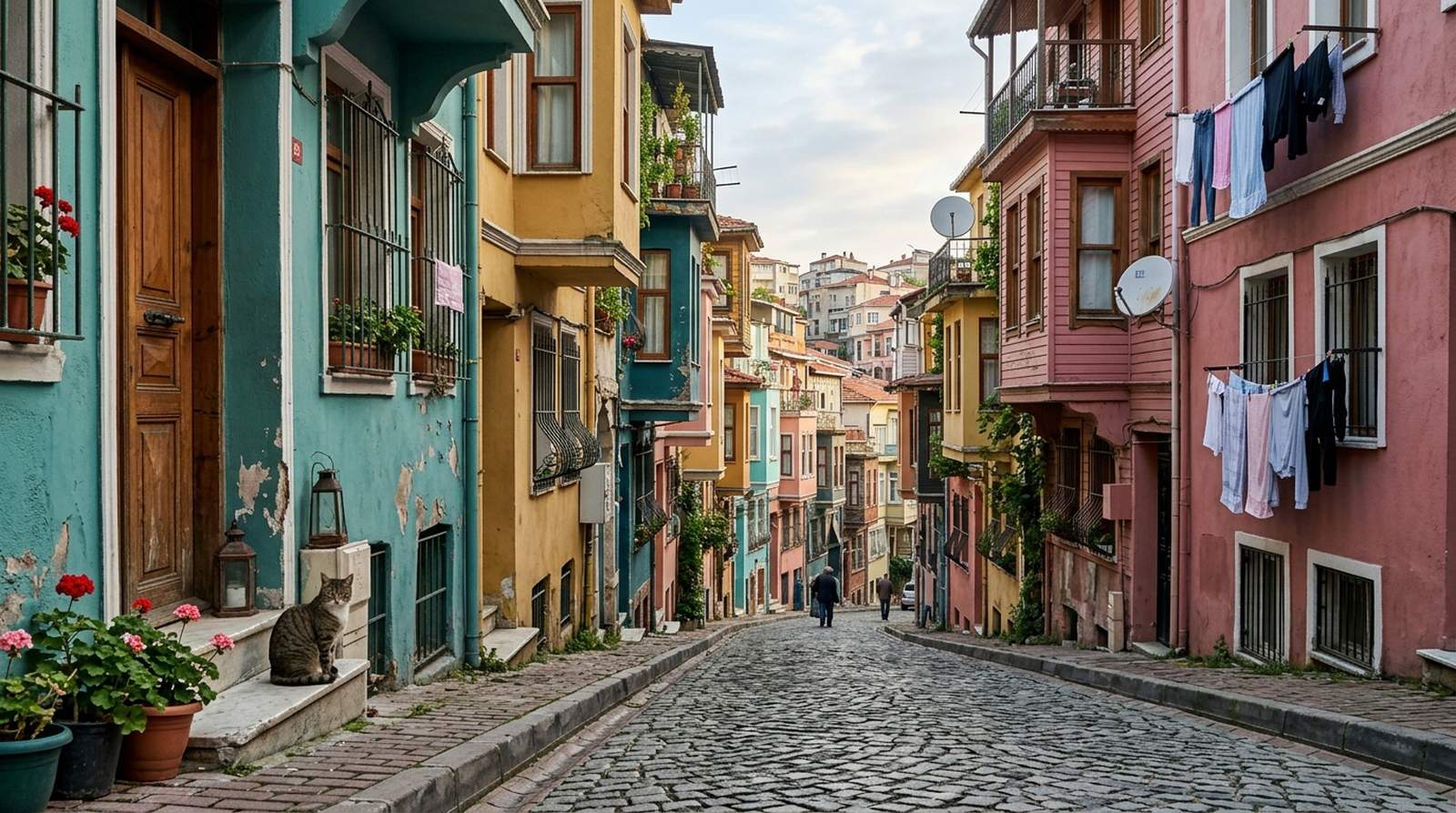
Contour along the hillside into Balat proper and find Kiremit Caddesi, the street of candy-colored 19th-century row houses — teal, mustard, rose — that made the neighborhood famous. The parallel lanes (Yıldırım Caddesi, and the much-photographed staircase streets off it) are just as good with half the visitors. This is a lived-in quarter, not a set: photograph freely, but leave doorsteps and residents in peace.
Stop 4 — Antique row and the café courtyards (45 minutes)
Drop downhill to Vodina Caddesi, Balat’s spine: antique dealers spilling gramophones and brass scales onto the pavement, vintage-clothes racks, and cafés in restored houses. The line outside the corner çölmek-lokanta means the stews are worth it. For coffee, the courtyard places around Merdivenli Yokuş — the postcard stepped street with the umbrella canopy — give you the neighborhood at its most photogenic. Balat rewards unhurried browsing; budget more time here than the distance suggests.
Stop 5 — The Iron Church (20 minutes)
Down on the waterfront park stands St. Stephen of the Bulgars, the “Iron Church” — prefabricated entirely from cast-iron panels in Vienna in 1898, shipped down the Danube in pieces and bolted together here. It gleams white and silver after restoration, and its iron columns and galleries feel uncanny once you realize nothing is stone. Entry is free; donations welcome.
Extension — Chora’s mosaics (add 1.5 hours)
If Byzantine art is your reason for coming this far, continue 1.5 km uphill to Chora (Kariye), whose 14th-century mosaics and frescoes outshine anything in Hagia Sophia. It is a steep walk or a five-minute taxi; combine it with Balat only if you started early.
Getting back — and a shortcut onto the water
Bus 99/44B returns you to Eminönü in fifteen minutes. If the timing works, do it the pretty way instead: the Golden Horn ferry glides you back past the city walls to the mouth of the Bosphorus. Back at Eminönü, you are standing at the departure quay for the classic Bosphorus sightseeing cruise — the natural way to end a Balat day, seeing from the water the shoreline you have been walking above. Compare the cruise options at bosphorusistanbultours.com before you queue at the kiosks.